(2025-11-20) Strickler A Theory Of Groupcore
Yancey Strickler: A theory of groupcore. Metalabel exists to make groupcore: software, tools, ideas, and spaces that help people cooperate.
But can one groupcore as a verb? How do you do it? How is it similar to other forms of coordination we already know?
What groupcore is
Groupcore is a term we use for the loose, rotating circles of collaboration and work that the internet makes possible. To groupcore means being part of multiple collaborative spaces (IRL and online) where you make things with other people — some that pay money, some that don’t — that together form the basis for doing things with others, financially supporting yourself, and manifesting parts of who you are.
It’s an underlying mode, like open source or co-ops, that anyone can participate in. Groupcore happens when people seek cooperation that preserves autonomy, distributes authorship, and generates outcomes none could make alone. (see (2012-01-12) Carson Deep Trust Shallow Trust And Phyles)
Practically, groupcore looks like a post-industrial guild, a scene, a metalabel, or a people-controlled DAO: a horizontal network overlapping in skill, interest, location, or history, where efforts may alternately compete, conflict, or collaborate
Groupcore is fractal. Each level and phase of a groupcore effort is a reflection of its larger self. The roles within a groupcore project reflect the group’s norms and vibes (positive and negative).
Groupcore is anti-fragile. Groupcore practices do not rely on a single product or source of income. This diversified structure makes them inherently anti-fragile. It encourages a high turnover of small ideas with distributed authorship and low fixed costs.
What groupcore is not
Poly not mono. Traditional orgs have fixed borders that establish authority and direction. Groupcore orgs are nodes that simultaneously participate in many different projects and configurations
Lattices not skyscrapers. Groupcore projects are interlinked and networked more than hierarchical
Fluid not fixed. Groupcore projects focus on a specific vibe or outcome while maintaining a sustained fluidity in how they get there.
groupcore is not something or someone you “work for” but a conscious path of open-ended labor.
How to groupcore (basics + stack)
a few key elements are needed
Purpose. To properly groupcore, there must be a shared interest or goal
People. Who do you make things with?
Responsibilities. What does it mean to be part of your group?
Outcomes. What’s meant to happen as a result of coming together? Are the goals financial, impact, or something else?
a few shared tools are needed:
Shared intentions and language. Agreement and language are key tools for any groupcore endeavor. (shared language)
Shared communication spaces. Most activity happens in shared communication environments, usually a group chat, with occasional voice or video calls and IRL gatherings.
Shared brain. The shared communication channels generate collective knowledge and understanding, recorded and inscribed in the group’s shared brain — perhaps a mutually accessible folder, single master document, or something more or less formal.
Shared resources. The group must be supported by a set of shared resources, like audience, money, reputation, ability to infiltrate or influence desired parties, and so on.
Groupcore decision making
a groupcore project will begin to operate according to its nature. These ideals tend to be defined in theory and realized in practice across a few key axes:
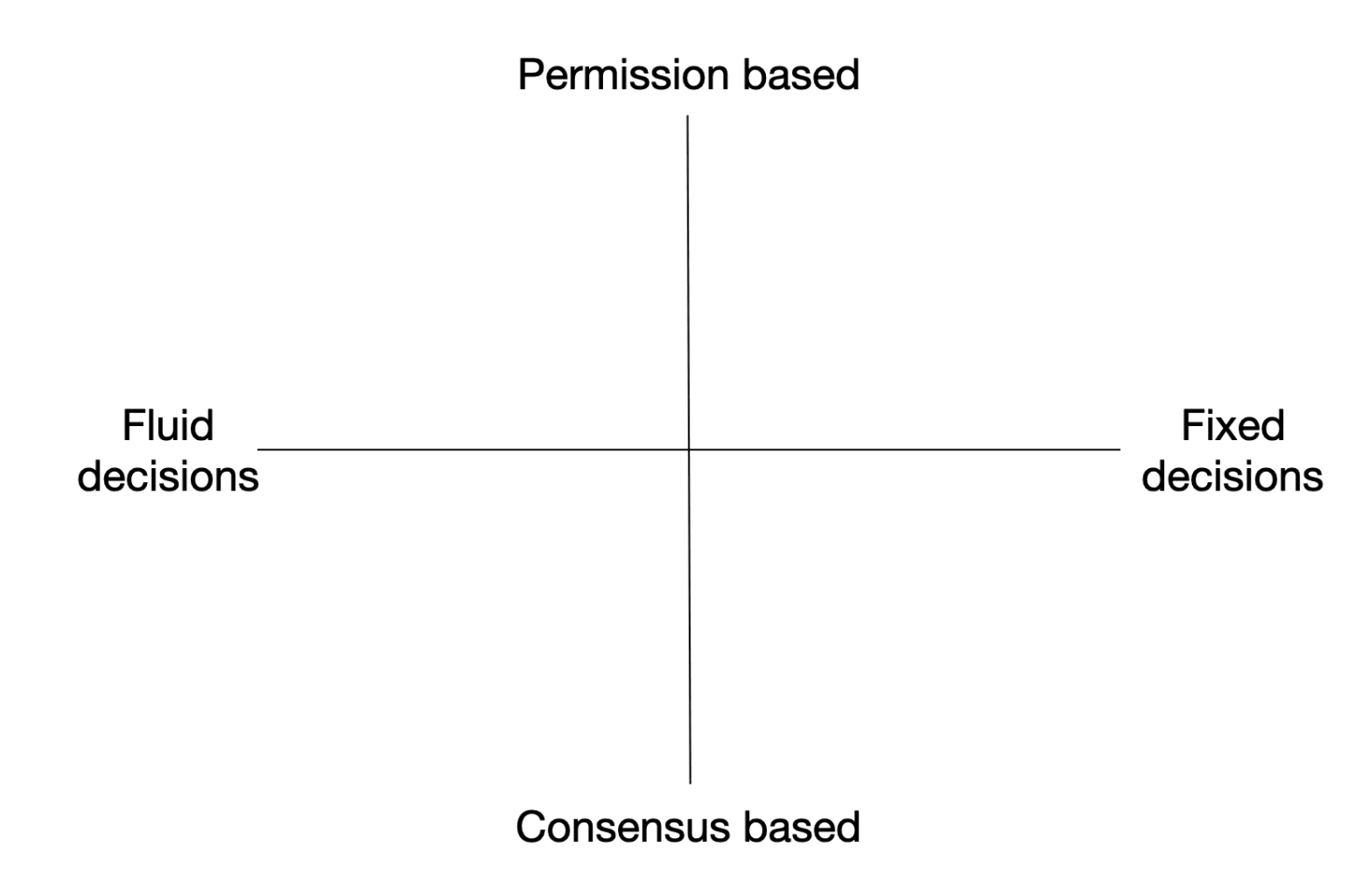
Decisions. How are decisions made? Does everyone get a chance to weigh in
Proposals. Do you need to propose or can you just do things?
Consent and dissent. Is everyone expected to agree with everything that goes on?
Norms. Is the internal structure and process of the group fixed and defined by preset rules
Groupcore can take many forms, from intentional democracies and co-ops to anarchic free-for-alls and Dark Forest conspiracies.
The difference is in how power, attention, and care are handled.
How Metalabel works together
For the past four years, Metalabel has been an exploration and manifestation of groupcore ideals. We initially called these structures “culture labels” and “metalabels” – psychic infrastructure that allows groups of people to cooperate in creative fields.
From the beginning we adopted the working structure of a heterarchy — a fluid hierarchy where a different person is empowered to make a final decision based on the area of expertise. Each person has a domain in which they’re expected to act and make calls as they see fit, and as it coheres to the larger vision of that project.
A heterarchy is a high-trust structure that relies on rapid decision-making, low egos, and comfort with a fluid approach.
Metalabel the lattice
In this diagram, the center node is Metalabel Studio – the core group and heterarchy where decisions are made, ideas are shaped, and responsibility is ultimately held.
At the bottom, two nodes anchor the structure:
- People. The four of us at the core plus our wider network of contributors, allies, and our past collaborators.
- Responsibilities. The shared work each of us holds in our domains.
When this base combines with our purpose and outcomes, it results in the releases that express our work.
One of the most significant is the Metalabel marketplace — infrastructure and space for cooperative releases. This is where most people first encounter us. We spent two years building its architecture, product, and community
Today the work is managed by a smaller subsection of our team focused on curation and customer support. 30,000+ collectors, 1,000+ creators, and nearly $2 million in transactions have moved through this over the past three years.
Our experiences with the Dark Forest Collective led to Artist Corporations. This is a proposed legal structure
One group releasing on Metalabel is the Dark Forest Collective, a writer group that uses our tools to release books and experiment with shared finances and treasuries. We started and continue to organize this project, which has put out three books so far.
Our other focus, the Dark Forest OS (DFOS), is a software project that encodes groupcore patterns into a product that anyone in this lattice will be able to use
How we manage these projects
team of four.
Decisions. Make as few decisions as possible. Strive to operate in a flow state where one project leads to the next.
Norms. Over time we’ve developed a set of norms that have served us well, like release culture, metablogs, and egalitarian pay and equity.
Hands-on. We all perform different specific jobs. There are no managerial or purely administrative role
Sequential. A benefit of the release-based structure we use: we tend to go all in on a project for a set amount of time before shifting onto the new one. Even as we’re managing multiple simultaneous projects now, they began at different times, require different people, and do not compete with each other for resources.
Make what we want. We project our own groupcore patterns into products and tools for others to follow or fork.
Everything points in the same direction. When we look at our portfolio of projects, we see the same ideas repeatedly expressed in different ways.
A groupcore future
We’re deeply inspired by the idea of the Hacienda from an early Situationist manifesto. The Hacienda is the place where all the right people are having all the right conversations and life remains alive. (see OpenSpace
Groupcore is less an end-state than a state of being.
Edited: | Tweet this! | Search Twitter for discussion

 Made with flux.garden