(2024-05-12) Dreyfus What Comes After Roams Renaissance
Itay Dreyfus: What comes after Roam's renaissance? A new year has come. It's 2024 and note-taking isn’t cool anymore. The once-blooming space has had its moment. Moreover, the almighty Roam Research isn’t the only king anymore. The hype is officially over.
Roam was one of those phenomena that happen every other few years. Its appearance in our lives not only made the “tools for thought” niche fashionable. It marked a new era in the land of note-taking apps. In conjunction with a flourishing movement of internet intellectuals, it sparked a tsunami of new tools.
In the post-mortem of the note-taking mania, Roam’s hype was replaced by dramas, scandals, and rants questioning its future. Although Roam is still very much alive and kicking, its legacy can already be seen.
The Roam effect
2020 is best known for the breakout of a historic pandemic. In the parallel tech universe, it was also the year when note-taking apps went off the charts, and not only by user surging.
After we’ve learned how to build a second brain in Notion, it was time to move forward to more advanced concepts. The rise of Roam popularized quirky terms like Memex and Zettelkasten to a broader audience.
The small niche soon turned into a vibrant community. At one point it seemed everyone had become zealous note-takers.
Outlining the outline
Taking notes usually happens in the form of bullet points. It's one of the most effective ways to extract thoughts into a written or typed word.
The bullet point doesn’t need an introduction. It's an ancient convention for everyday tasks like to-dos and grocery lists. However, it went under the radar in modern software
I've been pondering on the reasons why.
Modern design thinking (sorry, not this) would probably try hard to manipulate and overdesign the bullet point pattern until it embodies legitimate 21st-century aesthetics. Its wide acceptance across many communities is completely dissonant with mainstream design culture.
Popular document-based tools like Notion and Coda have built their products with a visual approach
Prompting a command menu by typing "/" to insert built-in widgets like image galleries or rich data tables now seems ubiquitous in software across many fields.
Although borrowing the same slash-to-command feature, Roam embraced a more unconservative approach.
As Dan Shipper put it:
The underlying genius of Roam is that it is structured not like a tool, but like a programming language.
The Fall of Roam
Indeed Roam is very much inspired by a niche programming language called Clojure. Furthermore, it's built with it
Over the past few years, we’ve seen a growing number of productivity and note-taking apps. Like Roam, they are all document-centric, with an editor at the heart of their products. Yet, they reside in a distant corner of the matrix. See 2x2
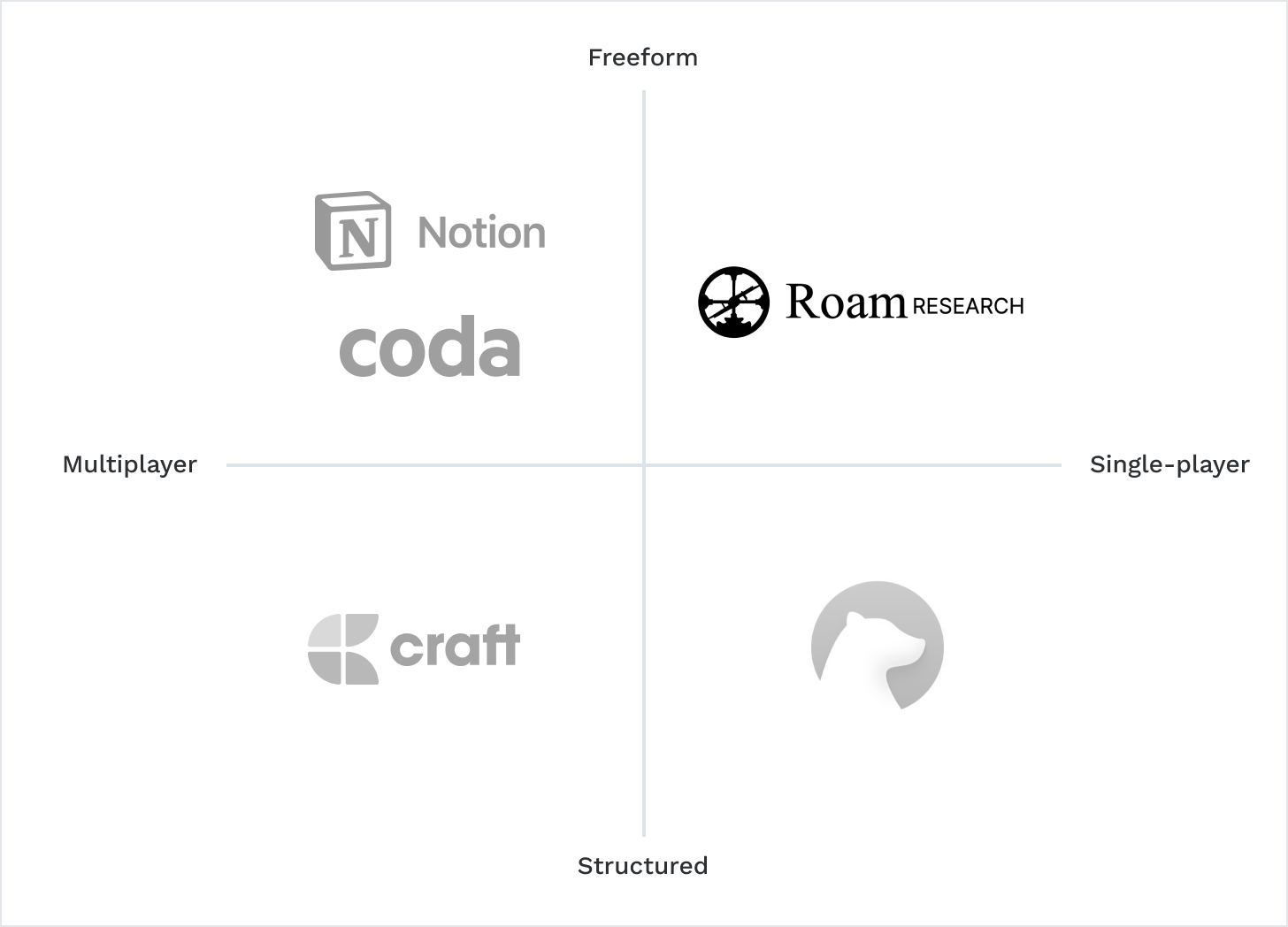
At its core, Roam is an Outliner
Despite its long history, Outliners remained a tiny niche.
Roam's extreme minimalist design might look simple on the surface. It suggests a simple, even dull interface to work in.
Over the last decade, we've seen "complex" design patterns evolve. The infinite canvas, chatbot interface, and even the command line have become omnipresent in today’s tools. Compared to bullet points, these patterns are more appealing: sleek, and playful to use.
One of the things Roam excels at is remixing ideas—turning old ideas into modern art. A prime example is the revival of bi-directional linking, an idea first described as “associative trails” in Vannevar Bush's 1945 essay “As We May Think”
A decade and a half later, Ted Nelson began working on a hypertext system, known as “Project Xanadu”.
While being influential in the development of the World Wide Web, both projects fell short of their original visions. In hindsight, they might be considered instances of technology being ahead of time.
Nevertheless, it had to take a few more decades for the same idea to resurface again.
On nonlinear-ism
Traditionally, modern software is designed in a linear structure.
All this makes sense, as linearity is a human structure
experiences are designed in a linear, progression path. (Usually!)
And yet, Roam had challenged this approach.
After signing up, it seems like you get dropped into the deep water without any buoy.
It's the “blank page problem” in its all glory.
Unlike most software, Roam is non-linear by nature
Roam acts as a time machine
The Roam workspace is called a knowledge graph, and it takes a different approach. There’s no top-down hierarchy
These nodes become overwhelming very fast. Piles of texts get stacked and pages become scattered, conveying a sense of losing control. I remember this odd feeling just from visiting Roam's homepage for the first time.
Mastering Roam involves a daunting learning curve, not just in terms of the hours invested but in the depth and complexity of the knowledge required. In that sense, Roam reminds the process of learning a new skill, rather than a product.
Roam popularized the networked thinking method, transforming it from an unheard-of niche to a widespread practice. It led people to switch from the librarian to the gardener mode, advocating a manifesto switching away from Evernote.
The rumor about an exciting new tool quickly spread. It had fulfilled the dream of any Silicon Valley-based startup: becoming recognized by the upper class. Kevin Rose, Patrick Collison, Venkatesh Rao, Erik Torenberg, Jeff Morris Jr. , and visakan veerasamy were among the first investors and customers.
However, its success created a vacuum. As a company that drew so much attention, it developed high expectations from the vast crowd. Once Roam started to feel stale, fans turned into vocal critics
people abandoned the allegedly sinking ship to find others to jump onto. Ironically, it was Roam that paved the way for alternatives. As soon as Roam gained traction, it proved there was room for more networked thinking tools.
Yet, the decline of Roam's popularity isn't tied only to its seeming lack of growth or scale. In other posts, writers Casey Newton and Dan Shipper describe a shared experience. It seems to be a misalignment between the tool and its premise:
But the original promise of Roam — that it would improve my thinking by helping me to build a knowledge base and discover new ideas — fizzled completely.
From a personal standpoint, I can relate to this notion. I’ve never been an avid note-taker. The least I do is open the Apple Notes app or sketch down ideas and wireframes in my sketchbook. Finding a systematic way to capture thoughts and ideas was never my thing. It always seemed too rigorous to me
Finding a soul as a product today seems rare in software.
More profoundly there’s this idea of smallness I adore, once brought to my attention by designer Ben Pieratt:
What I’ve noticed since leaving Svpply is that other industries treat their 1% differently
The desire to build an empire, instead of a small village, is one of the biggest evils in tech
User declining might be a negative metric for showing in investor updates. However, in some cases, such a scenario can be quite healthy for a product to sustain. Roam’s fall may not be that genuine after all.
the smallness thesis seems to apply to Roam. Eliminating the noise is a good quality for any software, especially after a super-hype that everyone wants to be a part of. It only makes sense that not all of Roam’s early adopters were the right audience
It seems that Roam found its true believers, and not just those who once purchased a Believer plan and canceled it. Roam's community may have shrunk, but it remains strong.
From the beginning, there was something about Roam’s simplicity
The monotony of its homepage and “boring” colors reflected a sense of boredom. It felt naive but in a good way.
It didn’t look like a copycat.
Instead, Roam was, and still just being itself.
Edited: | Tweet this! | Search Twitter for discussion

 Made with flux.garden